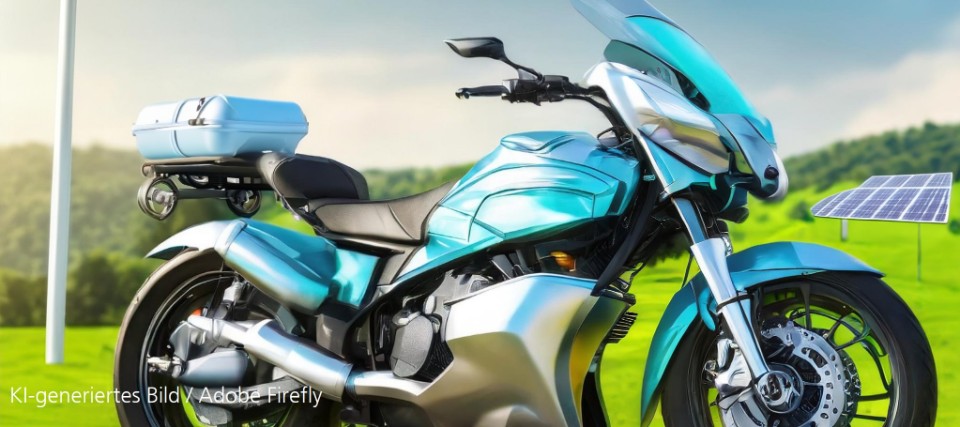
The aim of the collaborative R&D project “Hydrocycle” is to research and develop a hydrogen-powered light vehicle. Such vehicles will be needed on the market to meet the European Commission's mobility goals (Green Deal) by 2050. Both the European Union and the member states themselves regard hydrogen as the energy carrier of future mobility.
The innovative fuel-cell stack to be further developed by WätaS Wärmetauscher Sachsen GmbH is the key technology of the project. Research into new manufacturing approaches and functionalities of the fuel-cell stack is supported by Fraunhofer IWU, which also tests the integration of the new development into the vehicle concept. 1to1design s.r.o. and the Faculty of Transportation Sciences at the Czech Technical University in Prague develop and validate approaches for the design and hybridisation of the drivetrain concept; ÚJV Řež, a. s. contributes expertise in developing fuel-cell vehicles and provides testing capacity.
In this way the project contributes to CO₂-neutral urban and interurban mobility and has positive effects on road-traffic noise and the space required by vehicles. Within two years, integration and manufacturing approaches are to be developed, technologies tested, prototypes built and the results demonstrated in a prototype demonstrator vehicle.
The project has the potential to serve as a reference for mobile fuel-cell applications, in order to understand, reproduce and find solutions for application-specific challenges of the (automotive) industry.
Objectives
- Develop integration and manufacturing approaches for the fuel-cell drivetrain
- Test technologies and build prototypes
- Demonstrate the results in a prototype demonstrator vehicle
- Contribute to CO₂-neutral mobility